
-
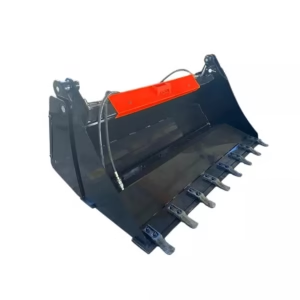
4 in 1 Bucket Attachment for skid steer loader
Price range: £1,950.00 through £2,450.0060" – 84"Select options This product has multiple variants. The options may be chosen on the product page
Weight (Kg) 385 – 582
A Grade
MAKE-Contract -

Rock Bucket Attachment for skid steer loader
Price range: £1,190.00 through £1,560.0060" – 84"Select options This product has multiple variants. The options may be chosen on the product page
Weight (Kg) 240 – 320
A Grade
MAKE-Contract -

Standard Bucket Attachment for skid steer loader
Price range: £990.00 through £1,190.0060" – 84"Select options This product has multiple variants. The options may be chosen on the product page
Weight (Kg) 240 – 320
A Grade
MAKE-Contract -

Stump Bucket Attachment for skid steer loader
£890.00Weight (Kg) 280Order Now
A Grade
MAKE-Contract
Bucket Attachments for Skid Steer Loaders (1–5 Ton)
1. PURPOSE
This document provides a comprehensive technical reference for skid steer loader buckets, covering:
Construction and operating principles
Hydraulic and mechanical systems
All major bucket types and their functions
Maintenance and service requirements
Safety, inspection, and troubleshooting
It is intended for operators, maintenance technicians, and supervisors responsible for safe and efficient use of bucket attachments.
2. SYSTEM OVERVIEW
A bucket is the most common and versatile attachment for skid steer loaders. It is designed for:
Excavating and trenching
Loading and carrying bulk materials
Grading, leveling, and backfilling
Spreading, clearing, and site cleanup
Buckets attach to the loader arms using a universal quick-attach plate, compatible across most brands (Bobcat, CAT, JCB, Case, Gehl, etc.).
They can be mechanical (fixed) or hydraulic (actuated) depending on whether they use auxiliary oil flow to control secondary movement (e.g., grapple, 4-in-1, side dump).
3. DESIGN & CONSTRUCTION
| Component | Description | Function |
|---|---|---|
| Bucket Shell / Body | Curved or flat-bottomed welded steel structure. | Holds, moves, and dumps material. |
| Cutting Edge | Hardened replaceable wear edge at the front lip. | Penetrates soil or aggregates. |
| Teeth (Optional) | Bolt-on or welded tips made from forged steel. | Break compacted ground or rock. |
| Side Plates / End Walls | Reinforced structural panels. | Provide strength and contain material. |
| Top Rail / Backplate | Reinforcement at top rear section. | Increases rigidity and resists bending. |
| Mounting Plate | Universal quick-attach interface. | Connects bucket to loader arms. |
| Hydraulic Cylinders (if fitted) | Double-acting cylinders. | Power clam, grapple, or dump functions. |
| Pins & Bushings | Hardened steel rotating joints. | Allow motion between jaws and main body. |
Most high-quality buckets are fabricated from high-tensile steel (Grade 50 or Hardox 400) with hardened cutting edges rated to 400–500 Brinell hardness.
4. TYPES OF SKID STEER BUCKETS
Below are the primary categories of skid steer buckets used across construction, agricultural, and industrial applications.
4.1 General-Purpose (GP) Bucket
Description:
Standard bucket supplied with most skid steers.
Flat or slightly curved bottom, smooth or toothed edge.
Features:Balanced design for efficient loading/unloading.
Optional bolt-on edge for versatility.
Applications:Earthmoving, digging, backfilling, loading soil or gravel.
4.2 Heavy-Duty (HD) Bucket
Description:
Reinforced version of the GP bucket with thicker side plates and wear strips.
Features:Designed for high-impact work and abrasive materials.
May include corner gussets or heel plates.
Applications:Construction sites, demolition debris, rock, compacted clay.
4.3 Tooth (Digging) Bucket
Description:
Standard bucket fitted with replaceable forged steel teeth on the cutting edge.
Features:Enhanced ground penetration.
Teeth bolted or welded for easy replacement.
Applications:Excavation, trenching, clay, compact soil, or quarry use.
4.4 Smooth-Edge (Finishing) Bucket
Description:
Flat, smooth lip with no teeth.
Features:Leaves a clean finish on surfaces.
Applications:Asphalt, concrete, sand, landscaping, and finishing work.
4.5 4-in-1 Combination Bucket
Description:
Multi-purpose hydraulic clamshell bucket with a front jaw that opens and closes.
Features:Acts as a bucket, dozer blade, scraper, and grabber.
Controlled via auxiliary hydraulics.
Applications:Site cleanup, backfilling, grading, gripping logs or debris.
4.6 Grapple Bucket
Description:
Open-frame bucket with upper hydraulic grapple arms for securing loads.
Features:Twin or single top clamps operated by auxiliary hydraulics.
Reinforced tines for debris handling.
Applications:Demolition, forestry, scrap, and landscaping work.
4.7 Rock / Skeleton Bucket
Description:
Bucket with spaced bars on the bottom and back.
Features:Allows fine material to fall through.
Captures rocks, rubble, or roots.
Applications:Site clearing, rock separation, land preparation.
4.8 Light Material / High-Capacity Bucket
Description:
Taller, deeper shell design for high-volume low-density material.
Features:Optimized for bulk handling, lower cutting edge stress.
Applications:Snow, mulch, sawdust, compost, grain, and fertilizer.
4.9 Side Dump Bucket
Description:
Bucket designed to dump to the left or right using hydraulic side cylinder.
Features:Allows dumping in narrow or confined areas.
Applications:Roadwork, trenching, backfill, and transport work.
4.10 Concrete / Mixing Bucket
Description:
Heavy-duty drum-style bucket with internal agitator.
Features:Mixes and pours concrete directly from skid steer.
Applications:Fence posts, small foundations, repair work.
4.11 Grading / Leveling Bucket
Description:
Wide, shallow, smooth-edge bucket for precision leveling.
Features:Flat back and long floor for even surface finish.
Applications:Finish grading, landscaping, spreading gravel.
5. HYDRAULIC SPECIFICATIONS (For Hydraulic Buckets)
| Skid Steer Size | Flow Range (L/min) | Pressure Range (bar) | Cylinder Bore (mm) | Typical Attachments |
|---|---|---|---|---|
| Small Frame (1–2 Ton) | 35–55 | 120–150 | 50–60 | 4-in-1, light grapple |
| Medium Frame (2–3 Ton) | 50–75 | 140–180 | 60–70 | 4-in-1, general grapple |
| Large Frame (3–5 Ton) | 70–100 | 160–210 | 70–80 | Heavy-duty 4-in-1, side dump, mixer |
Do not exceed flow or pressure limits — overpressure causes seal failure and oil overheating.
6. OPERATIONAL GUIDELINES
Ensure couplers are clean before connecting hydraulics.
Verify the bucket is locked securely into the quick-attach plate.
Always keep the bucket level when approaching a pile.
Tilt forward slightly when digging; level when carrying.
Do not overload — keep within rated operating capacity (ROC).
Avoid striking fixed obstacles with the bucket edge.
When grading, use float mode for smooth surface results.
For 4-in-1 and grapple models, avoid clamping beyond full stroke.
7. INSPECTION & MAINTENANCE
7.1 Daily / Pre-Use
| Check | Purpose |
|---|---|
| Cutting edge / teeth wear | Prevent loss of digging efficiency. |
| Side plates & welds | Detect cracks or fatigue. |
| Pins and bushings | Avoid excessive play and noise. |
| Hydraulic hoses (if equipped) | Prevent leakage and pressure loss. |
| Coupler cleanliness | Prevent contamination of hydraulic circuit. |
7.2 Periodic (Every 250 Hours)
| Task | Description |
|---|---|
| Replace worn cutting edge or teeth. | |
| Inspect and torque bolts on hydraulic cylinders and mount plates. | |
| Clean pivot points and reapply grease. | |
| Replace damaged hydraulic lines or fittings. | |
| Touch up paint or corrosion protection as needed. |
7.3 Annual / Major Service
| Task | Description |
|---|---|
| Replace all cylinder seals (hydraulic buckets). | |
| Replace bushings and pins showing wear. | |
| Inspect structure with NDT (dye penetrant). | |
| Check hydraulic system flow and pressure. | |
| Repaint and relabel for safety compliance. |
8. WEAR COMPONENTS
| Component | Material | Maintenance Action |
|---|---|---|
| Cutting edge | Hardened 400–500 HB steel | Replace at 50% wear. |
| Teeth | Cast or forged steel | Replace individually. |
| Bushings | Hardened steel or bronze | Replace annually or when excessive play develops. |
| Cylinder seals | Nitrile or Viton | Replace if leakage occurs. |
9. TROUBLESHOOTING
| Symptom | Likely Cause | Corrective Action |
|---|---|---|
| Poor digging performance | Worn edge or incorrect angle | Replace edge or adjust tilt. |
| Bucket won’t open/close | Low hydraulic flow or trapped air | Bleed system; check couplers. |
| Oil leak | Damaged hose or seal | Replace defective components. |
| Frame twisted or bent | Overload or impact | Repair or replace bucket. |
| Locking pins won’t engage | Debris or corrosion | Clean and lubricate latches. |
10. SAFETY INFORMATION
Only trained operators should use bucket attachments.
Always stay within load capacity limits.
Keep bystanders clear of work area.
Never use bucket as a lifting device unless certified for it.
Always travel with bucket low to the ground.
Depressurize hydraulic system before disconnecting hoses.
Use PPE — gloves, safety boots, eye and hearing protection.
Store bucket safely on the ground when not in use.
11. STORAGE & TRANSPORT
| Condition | Instruction |
|---|---|
| Short-Term | Park on level surface; bucket clean and lowered. |
| Long-Term (>3 months) | Grease pivots, oil exposed edges, store indoors if possible. |
| Transport | Secure using straps or chains through provided lift eyes; empty before transport. |
12. MAINTENANCE RECORD TEMPLATE
| Date | Technician | Hours | Model | Observations | Action Taken |
|---|---|---|---|---|---|
13. TECHNICAL SUMMARY
| Category | Specification |
|---|---|
| Machine Compatibility | Skid Steer Loader (1–5 Ton) |
| Mount Type | Universal Skid Steer Quick Attach |
| Bucket Width Range | 1,200 – 2,200 mm |
| Capacity Range | 0.2 – 0.8 m³ typical |
| Material Construction | High-tensile steel, 400–500 HB edge |
| Hydraulic Flow (for actuated types) | 35 – 100 L/min |
| Hydraulic Pressure | 120 – 210 bar |
| Lubrication | Grease every 10 hrs on pivots |
| Maintenance Interval | 250-hour check; annual overhaul |
| Noise Level | <85 dB typical |
| Safety Compliance | ISO 4413, ISO 12100, CE Machinery Directive |
Skid steer loader buckets are engineered for strength, versatility, and productivity.
Proper selection, regular inspection, and hydraulic compatibility ensure maximum efficiency, operator safety, and long service life across all applications — from fine grading to heavy excavation.
.