
-
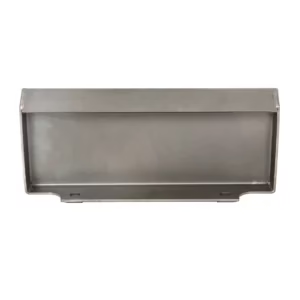
1/4″Thick Steel Mount Plate Mini Skid Adapter mini universal mount
£130.00Weight (Kg) 13Order Now
Professional Grade
MAKE-Contract -

Quick Attach Weld-On Mount Plate
£160.00Weight (Kg) 30Order Now
A Grade
MAKE-Contract -

Skid Steer Loader Quick Attach Coupling Assembly
£235.00Weight (Kg) 20Order Now
Professional Grade
MAKE-Contract -

SKID STEER to PTO ADAPTER
£3,860.00Weight (Kg) 158Order Now
A Grade
MAKE-Contract -

Universal Skid Steer Quick Tach Conversion Adapter Plate 4000lbs/1800 kg rating
£620.00Weight (Kg) 67Order Now
A Grade
MAKE-Contract
Technical Guide: Coupling Mount Adapters for Skid Steer Loaders
1. Overview
A coupling mount adapter (also known as a quick attach adapter or mounting plate adapter) allows skid steer loaders to connect with attachments not originally designed for their coupler type. These adapters are essential for cross-compatibility between different quick attach systems (e.g., Bobcat, John Deere, CAT, Euro, ISO).
2. Purpose and Applications
Primary functions:
- Interface between skid steer universal quick attach (SSQA) and other attachment systems (Euro Global, John Deere, Kubota, etc.).
- Enable attachment interchangeability across different brands.
- Provide secure mechanical coupling and, when needed, hydraulic line connections for powered attachments (e.g., augers, grapples, brooms).
Typical use cases:
- Retrofitting attachments from tractors or telehandlers.
- Standardizing fleets with mixed attachment inventories.
- Minimizing downtime and maximizing attachment utility.
3. Design Standards and Compatibility
| Parameter | Specification / Standard |
|---|---|
| Skid Steer Interface | SAE J2513 (Universal Quick Attach Standard) |
| Euro/Global Interface | ISO 23206 or EN 15431 |
| John Deere Hook & Pin | OEM dimensional specification |
| CAT/ASV/Terex | OEM proprietary coupler geometry |
| Material Grade | ASTM A36, A572 Grade 50, or equivalent |
| Finish | Powder coat or hot-dip galvanized for corrosion protection |
Key requirement:
Adapters should maintain alignment tolerance within ±1.5 mm across latch points to ensure safe coupling under load.
4. Mechanical Design and Construction
4.1. Main Components
- Mounting Plate (Primary Interface):
- Connects to the skid steer’s universal coupler.
- Typically a 3/8″ or 1/2″ thick A36 plate, laser-cut for accuracy.
- Attachment Receiver Frame:
- Welded or bolted to accommodate secondary interface (Euro, JD, CAT, etc.).
- Locking System:
- Uses manual or hydraulic pins/latches.
- Must conform to SAE J2513 latch engagement specifications.
- Reinforcement Gussets:
- Triangular gussets (6–10 mm thick) to prevent plate deformation.
- Optional Hydraulic Quick Couplers:
- For powered attachments; mounted on the frame with SAE J2044 quick-connects.
5. Material and Welding Specifications
| Component | Material | Thickness | Process |
|---|---|---|---|
| Mounting Plate | ASTM A36 or A572 | 9.5–12.7 mm (3/8″–1/2″) | Laser cut / plasma |
| Receiver Frame | A500 Grade B structural tubing | 50 × 50 × 5 mm | MIG welded |
| Pins & Latches | 4140 heat-treated alloy steel | Ø25–30 mm | Machined + zinc plated |
| Gussets | A36 plate | 6–10 mm | MIG welded |
Weld quality:
- Fillet welds ≥ 6 mm.
- Full penetration welds for primary load paths.
- Inspection per AWS D1.1 Structural Welding Code – Steel.
6. Hydraulic Interface (if applicable)
- Use ISO 16028 flat-face hydraulic couplers rated for 3000–5000 psi.
- Route hoses through abrasion-resistant sleeves.
- Include flow restriction valves if the adapter changes flow direction or attachment type.
- Label hydraulic ports clearly (IN / OUT).
7. Dimensional Tolerances
| Feature | Tolerance |
|---|---|
| Plate flatness | ≤ 2 mm per 300 mm |
| Pin hole center alignment | ±0.5 mm |
| Latch pin position | ±1.0 mm |
| Coupler engagement clearance | 1.0–1.5 mm |
| Overall frame squareness | ≤ 1.5 mm deviation |
8. Load Capacity and Testing
Design Load Rating:
- Equal to or greater than the maximum operating capacity of the skid steer (Rated Operating Capacity × 2.0 safety factor).
Static Test:
- Apply 1.5× rated load for 10 minutes without permanent deformation.
Dynamic Test:
- 10,000 cycles at 0.75× rated load to simulate attachment engagement/disengagement.
9. Safety and Compliance
- Provide a locking pin retention system to prevent accidental release.
- Ensure full latch engagement indicators (visual or mechanical).
- Add “No Step” and “Engage Lock Before Operation” decals.
- Follow OSHA 1926.602(a) and ISO 4413 (for hydraulics) safety standards.
10. Maintenance and Inspection
| Frequency | Task |
|---|---|
| Before each use | Inspect latch pins, coupler arms, and weld seams. |
| Weekly | Grease all pivot points (Lithium EP2). |
| Monthly | Check for plate warping, cracks, or loose hardware. |
| Annually | Repaint / touch-up corrosion-prone areas. |
11. Common Adapter Configurations
| Adapter Type | From | To | Notes |
|---|---|---|---|
| Skid Steer → Euro/Global | SSQA | Euro | Most common; fits agricultural attachments. |
| Skid Steer → John Deere | SSQA | JD hook & pin | For older Deere implements. |
| Skid Steer → 3-Point Hitch | SSQA | Cat I/II 3-pt | Includes top link receiver. |
| Skid Steer → Mini Loader | SSQA | Toro / Bobcat Mini | Light-duty only (<1000 lb). |
12. Example Manufacturing Process
- CAD Design & Simulation:
Use SolidWorks or AutoCAD for 3D modeling and interference checks. - Laser/Plasma Cutting:
CNC-cut A36 plates to ensure precision of latch points. - Welding & Assembly:
Use fixtures/jigs to maintain alignment during MIG welding. - Surface Prep & Coating:
Sandblast to SSPC-SP10, powder-coat to ≥ 70 µm thickness. - Inspection & Test Fit:
Verify fit on standard SSQA coupler, measure latch engagement.
13. Documentation and Labeling
Each adapter should include:
- Serial number and model ID.
- Maximum rated load.
- Manufacturing date and batch number.
- Operator’s manual and safety warnings.
14. Example Engineering Drawing (Text Description)
Front View:
- Width: 1180 mm (universal standard)
- Height: 460 mm
- Pin centers: 230 mm
- Plate thickness: 10 mm
Side View:
- Coupler angle: 15° back tilt
- Frame depth: 100 mm
- Gusset length: 150 mm at 45°