
[acadp_listings category=”300″ listings_per_page=”0″ featured=”0″ header=”0″ show_location=”0″ pagination=”0″]
1. Overview
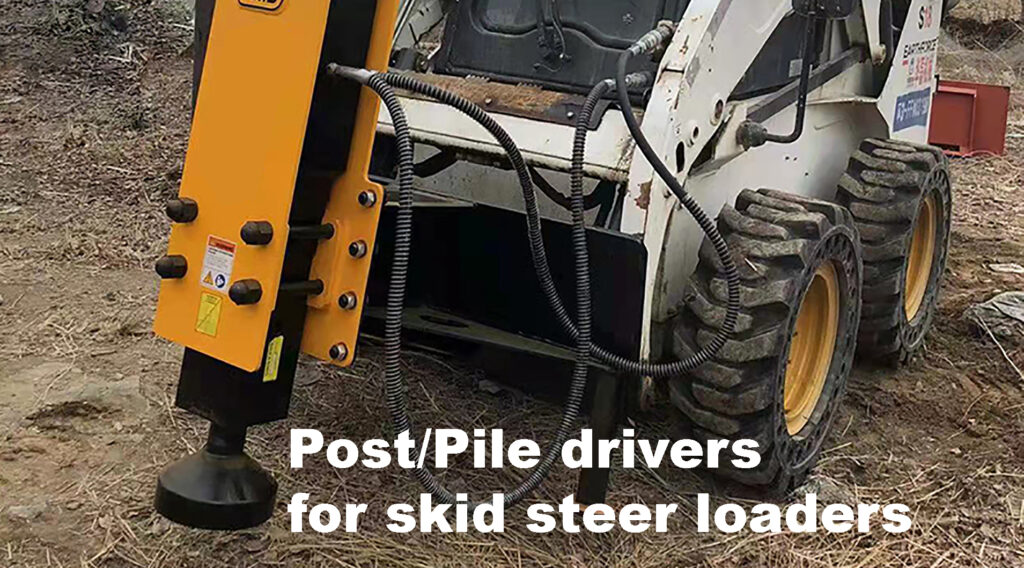
Post and pile driver attachments convert skid steer loaders into powerful tools for driving fence posts, signposts, guardrails, and foundational piles into the ground. These hydraulic-driven tools increase productivity and reduce manual labor on farms, construction sites, and fencing projects.
2. Types of Post/Pile Drivers
| Type | Description |
|---|---|
| Drop Hammer | Uses a free-falling weighted hammer; ideal for concrete or steel posts. |
| Hydraulic Post Driver | Uses hydraulic power to actuate a piston and drive the post; fast and precise. |
| Vibratory Driver | Uses high-frequency vibration to settle posts—suitable for softer ground. |
| Combo Driver/Puller | Some models can also extract posts using hydraulic pull. |
Hydraulic post drivers are the most common type used with skid steers due to their speed and efficiency.
3. Compatibility & Mounting
3.1 Mounting Interface
- Standard: Universal Skid Steer Quick Attach (SSQA)
- Some models may offer adapter plates for compact track loaders or backhoes
3.2 Size & Weight Considerations
- Verify attachment weight (typically 500–1,200 lbs)
- Ensure it does not exceed the lift capacity of the host skid steer
- Taller driver models require caution in low-clearance environments
4. Hydraulic Requirements
| Attachment Type | Flow Range (GPM) | Pressure Range (PSI) |
|---|---|---|
| Drop Hammer | N/A (gravity-driven) | N/A |
| Hydraulic Post Driver | 8–20 GPM | 2,500–3,500 PSI |
| Vibratory Driver | 10–25 GPM | 2,500–3,000 PSI |
Always check the manufacturer’s spec sheet for minimum GPM and max pressure rating.
5. Key Components
| Component | Function |
|---|---|
| Impact Head / Hammer | Delivers direct force to drive post into the ground |
| Guide Sleeve / Channel | Holds the post vertically for accurate alignment |
| Hydraulic Cylinder or Piston | Powers the hammer stroke (not present in drop hammers) |
| Mounting Frame | Connects the driver securely to the skid steer’s attachment plate |
| Control Valve / Solenoid | Activates impact motion from within the cab |
| Safety Guard / Post Cap | Protects the post head and operator during striking |
6. Operating Procedures
6.1 Setup
- Attach the post driver to the skid steer’s quick attach.
- Connect hydraulic hoses (verify coupler size and cleanliness).
- Test hydraulic engagement to ensure stroke or drop function initiates.
6.2 Driving Technique
- Align the post vertically inside the guide sleeve.
- Lower the driver head to rest on the post.
- Activate the hammer stroke using in-cab controls (joystick or auxiliary button).
- Apply consistent downward pressure as the post enters the ground.
- Monitor depth and plumb alignment throughout the driving process.
- Release and reposition for the next post.
For drop hammers, raise and drop repeatedly until post is driven.
7. Safety Guidelines
- Always wear hard hats, gloves, steel-toe boots, and eye protection
- Ensure no bystanders are within 25 feet during operation
- Do not strike concrete, rebar, or large rocks—may cause ricochet or damage
- Keep skid steer on level terrain to avoid tipping
- Shut down and relieve hydraulic pressure before maintenance
8. Maintenance Schedule
| Task | Frequency |
|---|---|
| Inspect hydraulic lines/fittings | Daily |
| Grease pivot points & bearings | Every 8–10 hours |
| Check piston seals and hoses | Weekly |
| Clean impact head and sleeve | After each use |
| Tighten bolts and frame lugs | Weekly |
| Replace worn post caps | As needed |
Use manufacturer-recommended grease and hydraulic oil. Avoid water ingress into impact components.
9. Common Applications
- Fencing: Agricultural, livestock, or perimeter fencing
- Construction: Guardrails, signage posts, and foundational piles
- Landscaping: Retaining walls, bollards, and vineyard posts
- Municipal Work: Street sign installation, parking barriers
- Oil & Utility: Temporary pipeline markers or pole base driving
10. Selection Tips
 Match GPM/PSI ratings to your skid steer’s hydraulic system Choose drop hammer if simplicity and low maintenance are preferred Select a hydraulic model for high-volume fencing or tough ground Look for replaceable post guides and caps to extend service life Consider tilt or alignment features if working on uneven terrain